A much-hated passenger tax that was introduced over a decade ago at Teesside Airport is to be abolished.
The controversial £6 ‘tax’ to fly from Teesside Airport will be scrapped from June 1, 2021. Called the Passenger Facilitation Fee, the charge was levied on every passenger that flew from the airport. It was introduced by the airports previous owners, Peel Airports, and followed similar schemes introduced to other regional airports like Blackpool, Newquay and Norwich.
The passenger levy was aimed to bring extra revenue to the struggling airport that was at the time witnessing dwindling passenger numbers. Further criticism of the fee was around the way it was collected, using payment machines that did not give change.
The then chief executive of Peel Airports, Craig Richmond defended the charges and even claimed the extra revenue raised would help secure new fight destinations such as Cyprus and Jamaica.
The implementation of the charge provoked a furious backlash from passengers and airlines alike, with many boycotting the airport. What transpired was the opposite of what Mr Richardson had envisaged, passenger numbers tumbled, and the airport went further into debt.
Tees Valley Mayor, Ben Houchen said: “When the tax was introduced back in 2010 everyone hated it; it drove passengers to Newcastle Airport and led to airlines leaving Teesside”.
Within days of the introduction of the tax Ryanair said they were considering withdrawing from Teesside. By the following year they were gone, swiftly followed in 2013 by Thompsons.
The airport, which was brought back into public hands two years ago, has seen money spent on its terminal and new flights have been secured.
Loganair have shown a long-term commitment to the airport with an ever-growing list of domestic destinations aimed at business travel, city breaks and staycations. Ryanair who has returned and were offering flights to Alicante and Majorca have announced they are also introducing flights to Corfu this summer.
Tees Valley mayor Ben Houchen hails investment at regional airport
Mr Houchen said: “We have made huge progress with Teesside Airport in an incredibly short period of time, but there is still a huge amount of work to do”.
Mr Houchen’ s Labour opponent in the forthcoming Teesside Mayoral elections, Jessie Joe Jacobs confirmed that she would continue with the airports 10-year rescue plan if she is elected next month.
Ms Jacobs said: “We are rightly proud of the airport and a huge amount of money has been committed to secure it’s future – £80 million and increasing – so let’s do something wonderful with that investment”. She added: “Under my leadership the airport will play a key part in bringing people into the vibrant Tees Valley”.
Tees Valley has seen an upsurge in its fortunes in recent weeks. First there was the announcement from the Chancellor that the Treasury was moving north to Darlington. This was quickly followed by the news that Tees Valley was one of the first places to get Freeport status under the new Government policy. Teesside Airport forms part of the Freeport.
Ten years ago, the small charge had massive consequences for Teesside Airport driving away passengers and airlines. With Mr Houchen and Ms Jacob’s optimism the airport looks like it is back on track. Only time will tell if the passengers who were driven to Newcastle or Leeds Bradford will return.
The UK’s foremost investor in battery technologies has selected a site in the North East of England to build the UK’s first battery gigaplant.
Britishvolt said it had bought the 235-acre (95 hectare) former Blyth Power Station site in Northumberland and intends to begin construction this summer.
The company which produces electric vehicle batteries has submitted a detailed planning application with Northumberland County Council for the scheme on the site. It is hoped that the scheme could ultimately create 8,000 new jobs at the plant and associated supply chain.
Total investment for Britishvolt’s gigaplant is £2.6bn, making it the largest industrial investment in the North East since Nissan’s arrival in 1984 and one of the largest-ever industrial investments in the UK. By the final phase of the project in 2027 it will be employing up to 3,000 highly skilled people, producing lithium-ion batteries for the UK automotive industry. It is envisaged it will create up to 5,000 jobs in the wider supply chain.
Britishvolt has entered into a collaboration agreement with Siemens to accelerate the development and production of lithium-ion batteries at the Blyth site. Siemens is providing Britishvolt with design and simulation development tools that will help accelerate the time it takes for lithium-ion battery cells to go from laboratory to production.
Britishvolt Chairman, Peter Rolton said: “This is a hugely positive and historic move forward for Britishvolt,” adding: “Northumberland County Council has helped us secure the best site in the UK for a gigaplant.” The site was bought for an undisclosed sum from the county council.
At the time of its closure, Blyth Power Station was the oldest coal-fired power station in Britain. There had been various plans to save the station, but they all fell through and the generation of electricity at the station ceased on 31 January 2001, after 43 years of operating, resulting in the loss of 131 jobs.
Britishvolt CEO, Orral Nadjari said “Blyth meets all of our exacting requirements and could be tailor made. It is on the doorstep of major transport links, easily accessible renewable energy, and the opportunity for a co-located supply chain, meets our target to make our gigaplant the world’s cleanest and greenest battery facility”.
He added: “We have had an extremely warm welcome from Ian Levy MP and Northumberland County Council and are looking forward to working with them closely on this project.”
Reacting to the news, Blyth Valley MP, Conservative, Ian Levy said: “This is an incredibly exciting announcement that will have a massive impact in the constituency and the surrounding area for decades to come. I can’t think of anything comparable in the North East since Nissan invested in Sunderland more than 35 years ago”.
Britishvolt’s gigaplant is widely regarded as being strategically important for the UK automotive industry to maintain competitive advantage as the country accelerates towards an increasingly electrified future.
The Britishvolt gigaplant will be built on a 95-hectare brownfield site and will use renewable energy, having the potential to use hydro-electric power generated in Norway and transmitted 447 miles under the North Sea via the world’s longest inter-connector from the North Sea Link project.
Prime minister Boris Johnson visiting the National Renewable Energy Centre in Blyth, Northumberland
The building of a battery gigaplant is also one of the key pillars of the British Prime Minister, Boris Johnson’s, ten-point plan for the UK’s green recovery and an important step to a Net Zero economy by 2050.
Last November Mr Johnson set out his ambitious plan for a green industrial revolution in Britain which he says will create and support up to 250,000 British jobs.
The plan covers clean energy, transport, nature, and innovative technologies and is part of the PM’s mission to level up across the country. At the centre of Mr Johnson’s blueprint are the UK’s industrial heartlands, including in the North East, Yorkshire and the Humber, West Midlands, Scotland, and Wales.
With cars and vans making up nearly a fifth of emissions, the government say they are taking decisive action to end the sale of new petrol and diesel cars and vans by 2030, with all vehicles being required to have a significant zero emissions capability (e.g. plug-in and full hybrids) from 2030 and be 100 % zero emissions from 2035.
To facilitate Mr Johnson’s ambitious plan and help alleviate concerns about the support framework for electric vehicles the government have pledged to invest £1.3 billion to accelerate the roll out of a charging infrastructure. There will be targeted support for rapid charge points on motorways and major roads to dash any anxiety around long journeys and the installation of more on-street charge points near homes and workplaces to make charging as easy as refuelling a petrol or diesel car.
All good news for Britishvolt and the North East economy.
The UK is already a leading a manufacturer of electric vehicles. The Nissan Leaf, produced in the UK, was the third highest selling EV in Europe in 2019. Currently there are over 100 models of electric vehicles on the market, and by 2025 half of all new cars produced will be electric.
The government have also announced a consultation on a date for phasing out the sale of new diesel heavy goods vehicles and are to invest £20 million next year in trials to pioneer hydrogen and other zero emission lorries.
By 2027 Britishvolt hopes to be producing enough batteries for 300,000 electric cars a year.
It has emerged that local politicians are in talks with Middle East investors and the government to try and secure a multi-billion-pound deal to create a new superport in the North East.
It is believed the scheme could be backed by Abu Dhabi based wealth fund Mubadala. Last month the investment company announced a joint venture with the UK government that, over the next five years, could see up to £5 billion spent on life sciences, technology, clean energy and infrastructure.
It is understood that as part of the deal discussions have taken place about a PD Ports takeover deal that would see the vast Teesside gateway location absorbed into the site. PD Ports are one of the major UK port groups, operating from 12 locations across the country.
A Government source has told a national newspaper: “One of the projects that we are working on with Mubadala is the acquisition of PD Ports, and to bring PD Ports into the wider ownership of Teesworks with various private partners.”
In his March budget, the chancellor, Rishi Sunak granted Teesport the ‘game changer’ freeport status, in a move that will “turbo charge Teesside’s economy” bringing thousands of jobs and a £3.2bn boost to the area.
Following the announcement Tees Valley’s Conservative Mayor, Ben Houchen issued a statement saying: “We’ve successfully secured the UK’s largest free port, the ownership of thousands of acres of brownfield land, millions of sq. ft of approved planning for factories, a new heavy lift quay and investors who have signed on the dotted line, and I’m in continuous discussions with Government and potential investors and funders to build on this fantastic start so we can create much needed jobs and opportunities for local people”.
He added: “What happens over the coming months is going to be crucial if we want to capture the once in a generation opportunity that now stands before us.”
Covering 4,500 acres, the Teesside Freeport will be the largest in the UK. It is hoped the development will create more than 18,000 jobs and provide a £3.2billion boost to the local economy over the next five years.
The Teesside Freeport covers sites across the region, including Teesworks, Wilton International, Teesside International Airport, the Port of Middlesbrough, the Port of Hartlepool, Liberty Steel and LV Shipping. The site would cover approximately the equivalent to 2550 football pitches.
The Teesside bid was one of eight successful bids across the country. All the bids were scored for performance on trade and investment, regeneration, innovation, pace of delivery, and private sector involvement.
It has emerged that another North East bid, centred around the Tyne, was ranked third out of 18 submissions on the Government’s criteria, narrowly ahead of the bid by neighbouring Teesside and significantly higher than several other successful bidders.
Although Teesside scored medium in three of the criteria and high on two others, on paper at least the North East Tyne bid edged it, scoring two mediums, two highs and one medium high.
Rushi Sunak was part of the controversial Freeport decision
The final decision was made by Mr Sunak and Communities Secretary, Robert Jenrick who agreed the Teesside bid should leapfrog the North East Tyne because of its “stronger alignment with Government policy, in particular the Net Zero agenda and the prime minister’s 10 Point Plan.” Locally these claims have been refuted because environmental factors were already included in the scoring system and the bidding prospectus.
It was hoped that a free trade zone across the ports of Tyne, Blyth and Sunderland, plus Newcastle Airport, the Nissan plant at Sunderland and the IAMP business park could create tens of thousands of jobs.
North of Tyne mayor Jamie Driscoll said: “The evidence shows we put in an exceptionally strong joint freeport bid from the North and South of Tyne. We scored higher than East Midlands, Solent, Plymouth and South Devon, Teesside, and Liverpool City Region, who all got freeports.”
The disclosure of the North East Tyne bid’s high ranking has re-opened a row on the way the Budget appeared to favour the Tees Valley over the rest of the North East, with six major schemes in that area getting funding from the Chancellor.
Critics have pointed out that these decisions have been made just two months before the area’s mayoral election. The satirical magazine, Private Eye noted: “What Teesside certainly scores highly on is alignment with the Tories. The outcome won’t harm Mr Houchen and the Tories’ local government election chances come May”. Pulling no punches, it went on to say: “Mr Houchen’s chances have been boosted by Mr Sunak’s choice of Darlington for the Treasury North outpost – once again ahead of arguably more suitable but politically less welcoming cities” such as labour dominated Newcastle.
The row also mirrors one that broke out last year around the Government’s Towns Fund, which appeared to favour seats being targeted by the Conservatives in the 2019 General Election. The Fund gave multimillion-pound funding to relatively prosperous areas ahead of more deprived towns after ministers intervened to overrule officials’ decisions.
Whilst investment in the North East is welcome and long overdue, questions will remain as to whether the preference of the Government for Teesside based projects are based purely on politics.
The Asian Standard contacted PD Ports for comment but has yet to receive a reply.
With the UK’s restaurants under lock and key, many of them face an uncertain future. New research polling 250 independent restaurant workers and 2,000 adults have revealed that 90 per cent of these establishments have faced the risk of permanent closure at some point during the Coronavirus pandemic.
British meal kit and recipe box retailer Gousto launches a campaign Cookstarter. The campaign aims to support Britain’s diverse food culture by helping independent restaurants thrive during the pandemic. Chef Gizzi Erskine, long-term ambassador Joe Wicks MBE, and comedian and self-confessed foodie Katherine Ryan have joined hands in the campaign.
People are encouraged to nominate their favourite local restaurants and UK-based independent eateries into Gousto’s Cookstarter campaign before 7th February.
Following a nationwide search, the campaign will see five much-loved independent restaurants receive £10k-worth of funding each. They will also be provided with a year-long business coaching support programme, spanning finance, marketing, HR, and product development from a dedicated Board of Mentors at Gousto. The program has been put together by CEO and co-founder Timo Boldt.
Alongside the year-long support programme, Gousto will collaborate with the five independent restaurants to create new recipes inspired by the restaurants for customers to enjoy at home. Every time a subscriber orders a Cookstarter recipe, they will be able to ‘tip’ the restaurant’s team through the cashless tipping solution TiPJAR.
Chef and restaurateur Gizzi Erskine commented: “For so many of us, the joy of dining is all about discovering new foods. We’re lucky to have such a diverse food scene in the UK, but this is at risk with independent restaurants having been hit hard in the past year. Diversity is at the heart of Britain, and our food culture is a huge part of that. We must pull together, show our support and stand up for the foodie gems that make this country so unique.”.
The campaign will go one step further to benefit the industry by encouraging people to donate to Hospitality Action. This charity supports all workers in the UK hospitality industry.
Research shows that 97 per cent of restaurants have had to pivot and adapt to the changing times. Sadly, with a substantial financial cost, 86 per cent have reported reduced profits, making it a tough year to stay in business.
Restaurants have had to adapt to changing regulations and fluctuating demand, with over half reducing their menu size in the past year, restricting the customers’ meal choice. Despite this, food wastage is at an all-time high.
But the country’s food culture is loved by many, and hunger for culinary diversity remains high. For most people living in this country, the UK’s unique food scene is one of their favourite things.
A massive 79 per cent of diners believe that independent restaurants are what makes Britain’s food scene so unique. Many would like to be able to do more to help them during this difficult time.
Kathryn Huxtable, Director of Food at Gousto, commented: “One of the best things about the UK is the variety, diversity and vibrancy of our amazing food culture. It’s so important that we rally together to preserve it. We want mealtimes to be full of adventure and discovery, which is why we want to play our part to ensure independent restaurants can survive and thrive through these troubled times.”
Angus Pride, Owner of Independent Restaurant Peru Perdu in Manchester commented: “It inspires hope to see the UK recognise the value of independent restaurants and champion our success after a difficult year. Funding is important, but the year-long mentorship offered by Gousto will be so helpful. It will provide the restaurant owners with the tools needed to overcome these challenging times and continue to provide the UK with the incredible food variety that we all value so much.”
Gousto’s Cookstarter campaign supports Britain’s diverse food culture by helping independent restaurants thrive.
You can Go to goustocookstarter.co.ukto nominate your can’t-live-without local restaurant by 7th February, giving them a chance to receive much-needed support.
Follow the campaign via @GoustoCooking #Cookstarter.
Debenham’s fallen kingdom in British High Street has allowed online fashion retailer Boohoo to snap it up at £55 million. The online fashion retailer has only bought Debenham’s brand and its website at this price. This means Boohoo is going to relaunch the department store as an online-only operation. They will not take responsibility to save any of Debenham’s 118 stores or the 12000 employees that come with it.
This paradigm shift highlights once again how the world has changed after the pandemic. The 243-year-old retail giant was, perhaps, the last soldier standing in British high Street, after the sad demise of BHS, Mothercare and many more.
Debenhams was in trouble for years with falling profits. Its struggles intensified by the coronavirus pandemic when shops were forced to close during the lockdown. Since the company went into liquidation in December 2020, administrators have been seeking offers for all or parts of the Debenhams business. Boohoo confirmed that it was purchasing the brand and its website, using its existing cash reserves, on Monday 25 January 2021. Experts consider that Boohoo is now in an even stronger market position by securing this deal than its competitors ASOS or Amazon.
So, who owns Boohoo and why has it bought Debenhams?
Boohoo is an online fast-fashion brand for women and men between 16 to 30. The Boohoo Group is owned by billionaire British businessman Mahmud Kamani. He co-founded the company alongside Carol Kane, the joint CEO of the brand.
Mahmud Kamani
Mahmud Kamani is an Indian-born billionaire who arrived in Manchester from Kenya in 1969 and sold handbags on a stall. He then invested his money in the wholesale business. He sourced garments from his native country for brands like Topshop and Primark.
The company that started with only three employees went onto become a global business with a 5000 strong workforce, in just 15 years. Mahmud Kamani is now one of the country’s most successful entrepreneurs with a net worth of just over £1billion.
The 15-year-old modern online retail upstart, Boohoo, has already snapped up prominent fashion brands like Oasis, Karen Millen and Coast out of administration. The online retailer has criticism for poor working conditions in its supply chain on several occasions. But it’s ability to promptly respond to the change of taste and style of today’s consumers have made its position strong in eCommerce today.
Kamani has earlier been surrounded by several other controversies, which include human trafficking. Boohoo’s Leicester based factory also came under the radar for forcing its employees to go to work while suffering from Coronavirus.
Why did Boohoo buy Debenhams?
Mahmud Kamani said, “The sale would allow Boohoo to become a leader in other retail categories and fashion, including beauty and homeware.”
Speaking about the deal, he said: “This is a transformational deal for the group, which allows us to capture the fantastic opportunity as eCommerce continues to grow. Our ambition is to create the UK’s largest marketplace.”
“Our acquisition of the Debenhams brand is strategically significant as it represents a huge step which accelerates our ambition to be a leader. Not just in fashion eCommerce, but in new categories including beauty, sport and homeware.”
Debenhams was a long-standing and leading UK fashion and beauty retailer with high brand awareness. Along with 118 departmental stores across the UK, it had an established online platform with approximately 300 million UK website visits per annum, making it one of the country’s top retail chains.
Luke Patel is a Partner at Leeds law firm Blacks Solicitors LLP specialising in commercial dispute resolution and heads up that team. Luke was the winner of the Best Professional in Business award at the Asian English Business Awards 2013. Described in the Legal 500 as “exceptional”, he primarily acts for individuals, owner managed businesses and SME’s in a wide range of sectors.
On Friday, the Supreme Court handed down its judgment in the Financial Conduct Authority (‘the FCA’) Business Interruption Insurance (‘BII’) case. The case was brought by the FCA on behalf of affected policy holders, the vast majority of whom were small and medium size businesses/enterprises. The key point of the case was to establish if policy holders were entitled to payments to cover losses suffered as a result of Covid-19. It was defended by eight insurers, who were several of the main providers of BII.
The court realised the importance of this case at the outset and stated that their aim was to give as much clarity as it could to as many policy holders/insurers as quickly as possible. It was agreed between the parties that the best way of doing this was to have the court consider a sample of 21 ‘standard form’ BII policies from 8 different providers. It is estimated that, in addition to the 21 policies considered, that there are likely up to 700 different types of policies, across 60 different insurers and 370,000 policy holders, which are likely affected by the judgment given.
Each of the policies considered contained a clause which afforded protection for business interruption, whether as a result of a notifiable disease outbreak (named ‘disease clauses’), the forced closure of premises/business activities (named ‘prevention of access clauses’) or hybrid clauses of the two.
In short, the Supreme Court when considering the policies largely agreed with the previous decision of the High Court and found in favour of the FCA and BII policy holders.
The Supreme Court carefully considered each category of clauses. A brief summary of the key findings for each are outlined below.
Disease clauses were those which typically covered business interruption losses incurred as a result of an occurrence of a Covid-19 within a specified radius of the business premises. The Supreme Court found that each case of Covid-19 was a separate occurrence and that the clauses would cover losses if there had been a case of the disease within the specified radius.
Prevention of access and hybrid clauses were those which specified a series of requirements before cover is provided (for instance, where restrictions are imposed by a public authority denying/preventing access to a business and this could have been as a result of a notifiable disease within a certain radius). The Supreme Court allowed that a mere instruction from a public authority (as well as compulsory rules/laws) could be considered an adequate restriction for the purpose of these clauses.
So, if a policy holder is afforded protection under one of the above types of clauses and if they can show that there was at least one case within the geographical area covered by the clause when the restrictions were imposed, they will likely be covered. The courts went into a great deal of detail as to what is likely to be considered adequate evidence of an occurrence of the disease for the sake of each claim. Details of these can be seen in the full judgments given by both the High Court and Supreme Court.
In respect of the losses suffered, the Supreme Court also stated that any trends or circumstances (such as a reduction in footfall for retail businesses) which arose out of the same underlying cause (the Covid-19 pandemic), should not be considered as a reason to reduce the losses when calculating what should be paid out.
The judgment has provided much needed clarity on an area which had already caused countless disputes between policy holders and insurers.
The wording of each policy will still need to be carefully considered to establish that cover is provided but in the event it is, it is hoped that the judgment will compel insurers to make payments as a matter of urgency to avoid the need for litigation from policy holders.
If you believe you may have a claim under a Business Interruption Insurance policy, or require guidance, please contact Luke Patel or Andrew Morgan on 0113 2279 270 or 0113 227 9355, or by email on LPatel@LawBlacks.com or AMorgan@LawBlacks.com.
The furlough scheme has been extended until the end of April 2021 with the government continuing to contribute 80% towards wages.
Mr Sunak also confirmed he would be extending the government-guaranteed Covid-19 business loan schemes until the end of March.
These changes come in the run-up to the next Budget, which the chancellor confirmed would take place on 3 March 2021.
Chancellor of the Exchequer Rishi Sunak said:
“Our package of support for businesses and workers continues to be one of the most generous and effective in the world – helping our economy to recover and protecting livelihoods across the country.
“We know the premium businesses place on certainty, so it is right that we enable businesses to plan ahead regardless of the path the virus takes, which is why we’re providing certainty and clarity by extending this support, as well as implementing our Plan for Jobs.”
Business Secretary, Alok Sharma, said:
“While our loan schemes have provided a vital lifeline to millions of firms across the country, we know that business owners need additional certainty as we head into the New Year.
“Extending government-backed loan schemes will give companies right across the UK the finance they need to support, protect and create jobs as we build back better from the pandemic.”
So far, the furlough scheme has supported 9.6 million jobs across the UK, with more than one million businesses using it.
Businesses will also be given until the end of March to access the Bounce Back Loan Scheme, Coronavirus Business Interruption Loan Scheme, and the Coronavirus Large Business Interruption Loan Scheme. These had been due to close at the end of January.
The schemes have already provided over £68 billion in guaranteed loans, and helped to keep afloat business in all sectors of the UK economy who have been impacted by coronavirus.
The UK economy grew by just 0.4% in October as the pandemic recovery continued to slow.
The Office for National Statistics said the economy remains well below the size it was before the pandemic began.
The UK has been recovering from a record slump earlier this year induced by the first coronavirus lockdown.
But output is expected to shrink again in November after England’s second shutdown forced firms to close.
The Office for Budget Responsibility does not expect the economy to recover to pre-coronavirus crisis levels until 2022 – or the end of 2023 in the event of a no-deal Brexit.
Jonathan Athow, ONS deputy national statistician for economic statistics, said: “The UK economy has now grown for six months running but still remains around 8% below its pre-pandemic peak.
“Public services output increased, while car manufacturing continued to recover and retail again grew strongly. However, the reintroduction of some restrictions saw services growth hit, with large falls in hospitality, meaning the economy overall grew only modestly.”
The economy initially rebounded at a record rate, and grew by 10.2% between August and October compared with the previous three months.
But growth has begun to slow – slipping from 1.1% in September – and the economy remains fragile, with unemployment continuing to surge.
Commenting on the October figures, Chancellor Rishi Sunak said: “I know people are worried about the winter months, but we will continue to support people through our Plan for Jobs to ensure nobody is left without hope or opportunity.”
The British Chamber of Commerce Head of Economics, Suren Thiru said:
“The sharp slowdown in economic output in October reflected the squeeze on activity from the re-introduction of tighter coronavirus restrictions, including the tier system in England. Firms in hospitality, who are most acutely exposed to the renewed restrictions, suffering particularly badly in the month.
“October’s slowdown is likely to be followed by a significant contraction in economic activity in November as the effects of the second coronavirus lockdown are felt, despite the prospect of a temporary boost from Brexit stockpiling.
“While a vaccine offers real hope, failure to avoid a disorderly end to the transition period or further lockdown restrictions before a mass vaccine rollout is achieved would severely drag on any economic recovery.
“Mass testing remains crucial to keeping the economy moving until the Covid-19 vaccine is fully rolled out. Achieving a UK-EU trade deal is critically important to avoid a damaging cliff edge for the UK economy. With time running out, government must work urgently to close the major gaps in the guidance available to help businesses to prepare for the end of the transition period.”
The Chancellor has set out what the UK government will spend on health, education, transport and other public services next year.
In a statement in the House of Commons Rishi Sunak also briefed MPs about the state of the UK economy and the latest forecasts for the UK’s public finances, which have been battered by the Covid pandemic.
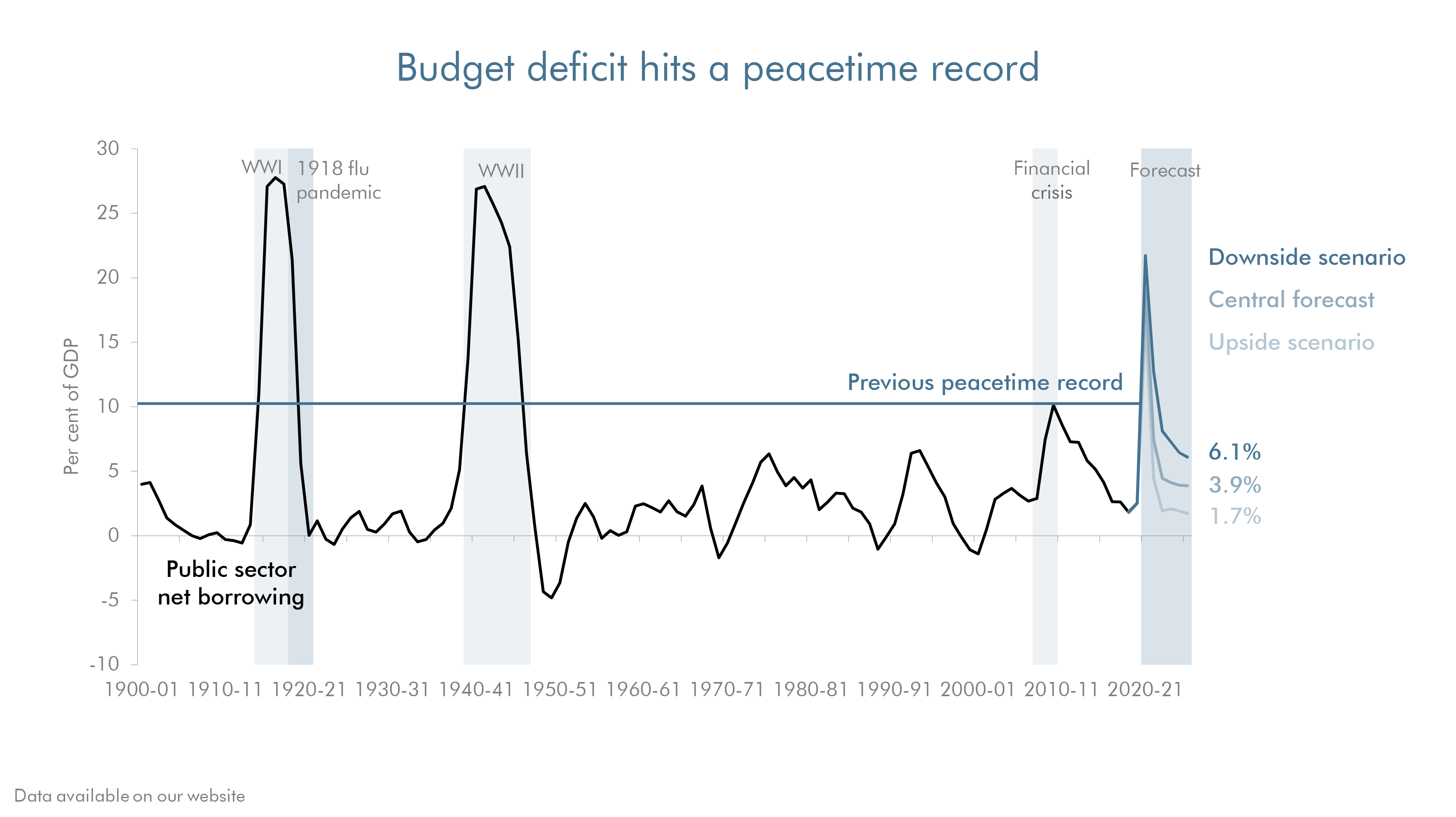
UK borrowing set to hit almost £400 billion by the end of the year, the economy is expected to contract by 11.3% the largest fall for more than 300 years and unemployment predicted to rise to 7.5% with 2.6m people out of work
The Office for Budget Responsibility says support for public services, households and businesses costs £280bn this year, pushing the deficit to £394bn, or 19% of national output, the highest ratio since 1944.
It puts and debt above 100% of output or gross domestic product for the first time since 1960.
Coronavirus pandemic pushes deficit this year to £394bn or 19% of GDP. Levels not seen since 1945-46.
“Our central forecast shows £20-30bn in spending cuts or tax rises would be required to balance revenues and day-to-day spending and stop debt from rising by the end of this Parliament,” it said.
A part of his speech Mr Sunak revealed the economy is forecast to grow by 5.5% next year and by 6.6% in 2022, 2.3% in 2023, 1.7% in 2024 and 1.85 in 2025.
Output is not expected to return to pre-crisis levels until the fourth quarter of 2022
UK debt will be equivalent to 91.9% of GDP this year and rise to 97.5% of GDP in 2025/26 In 2025, the economy will be around 3% smaller than was expected in March Budget forecast
In terms of the public sector pay millions of workers will see real-terms pay cuts next year as their pay is frozen.
Those earning less than £24,000 a year will get a minimum £250 increase.
Elsewhere in terms of wages, the Chancellor announced the National Living Wage is to rise by 2.2% to £8.91 an hour, with 23-year-olds qualifying for the living wage for the first time.
Labours Shadow chancellor Anneliese Dodds attacked the public sector pay freeze, saying it will deliver a “sledgehammer” blow to consumer confidence, while the Government had mismanaged the finances on an “industrial scale
TUC general secretary Frances O’Gradysaid: “For all the government’s talk of levelling up, this spending review will level down Britain, hitting key workers’ pay and breaking the government’s promises to the lowest paid.
“After a decade of standstill pay, yet another pay freeze is a kick in the teeth for the key workers in the public sector who kept the country going in this crisis.
Tracy Brabin MP for Batley and Spen said:
“When is a pause not a pause? When it’s a real term pay cut. That’s what the majority of public sector workers are facing, the Chancellor just couldn’t quite bring himself to tell people straight.
The government did their usual trick of floating the worst possible scenario in the press – a complete pay freeze – to try and make those who benefit thankful for their meagre rises.
The Chancellor seems to expect public sector workers – who have carried us through this crisis – to bare the burden of national debt while not touching tax dodgers like Amazon.”
On the National living wage increase Tracy added:
“Any increase is better than none, but let’s face it, it’s still not enough to live on and still not enough to pay the bills. I want better than that for West Yorkshire, that’s why I’ll put a Fair Worker Charter in place for our region in my first year in office if I’m elected.”
The Chancellor revealed that the overseas aid budget to be cut from 0.7% to 0.5% of total national income.
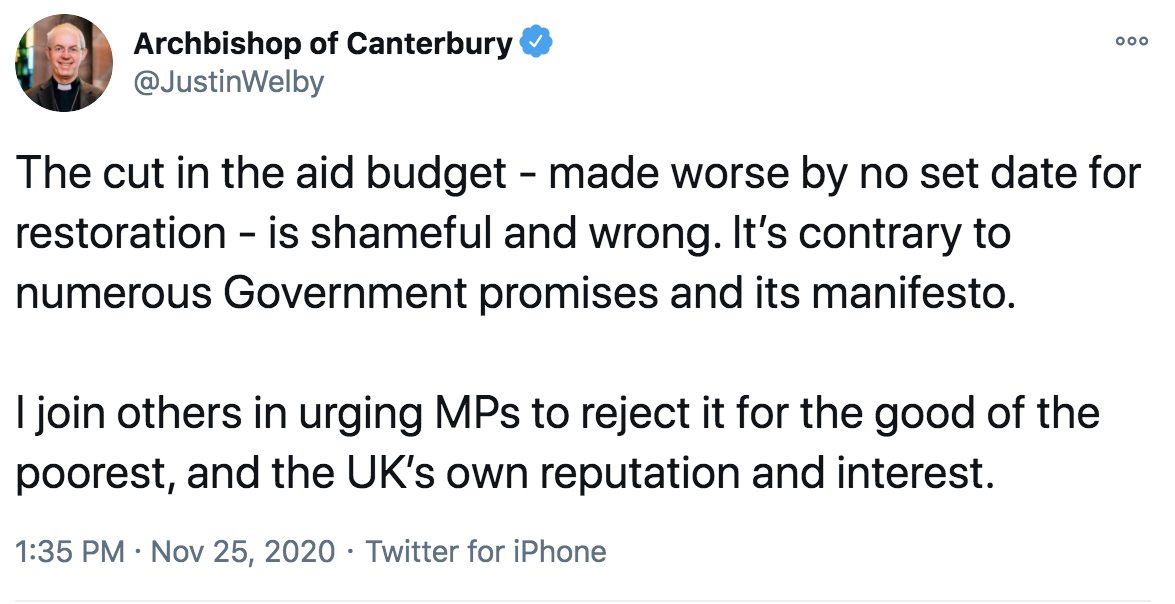
The decision has drawn criticism from The Archbishop of Canterbury, taking to Twitter, Justin Welby said: “The cut in the aid budget – made worse by no set date for restoration – is shameful and wrong.
“It’s contrary to numerous government promises and its manifesto.”
Archbishop of Canterbury criticised cutting the aid budget
Baroness Sugg has quit as a Foreign Office minister in protest at the government’s plans to cut overseas aid spending.
In a letter to the prime minister, Baroness Sugg said the decision to reduce spending was “fundamentally wrong”.
Adding that “Cutting UK aid risks undermining your efforts to promote a global Britain,
Along with decreasing the aid budget, the Chancellor confirmed the funding will go towards a new centre dedicated to artificial intelligence announced by the Prime Minister as part of the defence budget last week.
£3bn allocated to the Department for Work and Pensions in a three-year programme for supporting those who have been unemployed for 12 months to find work
For the health and social care sector it was announced £18 billion will be spent on Covid testing, PPE and vaccines.
The annual Health Budget will increase by £6bn which will include £3bn for the NHS to tackle the treatment backlog caused by the pandemic.
£500m will be allocated for mental health services. £325m to replace ageing equipment and £300m extra grant funding for councils for social care
Schools across England will receive a share of £2.2bn in funding.
Meanwhile, £2bn has been allocated for public transport,
Local Councils like Bradford and Kirklees will receive £3bn in extra funding with £250m for councils to tackle rough sleeping
Over £400m to recruit 6,000 new police officers by the end of 2022 has also been announced.
The Chancellor’s speech contained no major new green announcements, following last week’s unveiling of the Prime Minister’s 10 Point Plan, which was backed by £12bn of funding.
However, he reiterated the government’s commitment to a green recovery, highlighting increased investment in broadband and mobile coverage, upgraded railways, new cycle lanes, and over 800 zero-emission buses, while also touting the “biggest ever investment in new roads”.\
In the announcement, Mr Sunak said he wanted the UK to be a scientific superpower in a new National Infrastructure Strategy. The strategy would be supported by a new UK Infrastructure Bank that would be headquartered in the north of England that would work with the private sector to fund new investment projects across the UK.
Tracy Brabin welcomed the news of the location in the North of England but was cautious of the news
“You always have to be careful when commenting straight after a Chancellors statement because what sounds good from the dispatch box often has some nasty small print when you read the actual policies, but if the government are serious about investing in infrastructure, I’ll welcome that.
We hear headlines all the time with no action to back them up. If that funding is coming to the North, I want it to come here to West Yorkshire and if I’m our Mayor it will be at the top of my priority list.”
Chancellor Rishi Sunak said: “My number one priority is to protect jobs and livelihoods across the UK.
“This Spending Review will ensure hundreds of thousands of jobs are supported and protected in the acute phase of this crisis and beyond with a multi-billion package of investment to ensure that no one is left without hope or opportunity”.
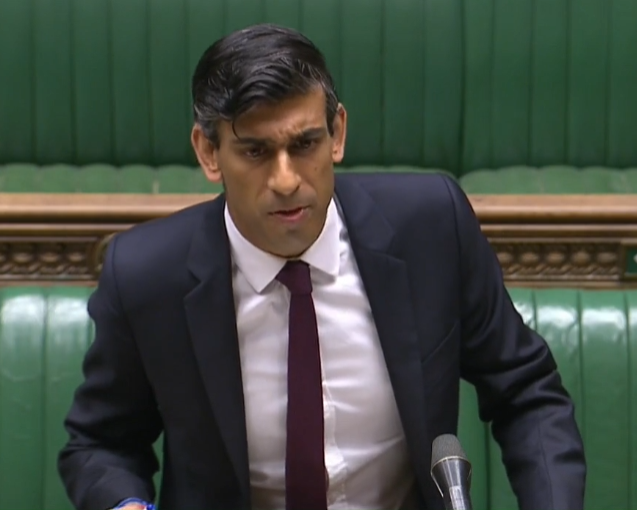
Chancellor Rishi Sunak before he delivered his spending review
Labours Shadow Chancellor Anneliese Dodds said a longer-term spending review was needed soon “to build a future for our country as the best place in the world to grow up in and the best place to grow old in”.
She criticised Mr Sunak for not mentioning Brexit in his speech, with the UK set to leave the EU single market and customs area at the end of the year.
She added: “There’s still no trade deal. So, does the chancellor truly believe that his government is prepared and that he’s done enough to help those businesses that will be heavily affected?”
The OBR said: “The economic outlook remains highly uncertain and depends upon the future path of the virus, the stringency of public health restrictions, the timing and effectiveness of vaccines, and the reactions of households and businesses to all of these.
“It also depends on the outcome of the continuing Brexit negotiations.”
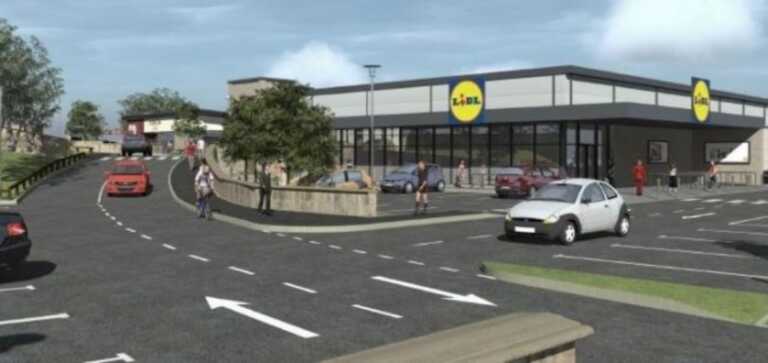
Plans for a new Lidl and a drive thru Costa Coffee on a Shipley site have been approved by Bradford Council.
Earlier this year it was revealed that the two big names were planning to open on the Airedale Mills site on Salts Mill Road, where Shipley meets Baildon.
An outline application to build a retail development on the site was approved in 2018, and now more detailed plans for the Lidl and Costa have been given the thumbs up from planning officers.
The plans also include the groundwork for “stage 2” which could see another two stores built on the site – which will be known as Shipley Wharfe Retail Park.
The site is the former home of Cardinal, a Bradford-based commercial interiors company that moved from the location in 2016. The company’s buildings and warehouses were demolished shortly after.
Pedestrian access from the town centre, as well as a public garden area, will also be included in the retail park’s layout. And the development will see improvements made to the walkway along the River Aire, which runs behind the site.
Morbaine, the property developers behind the scheme, had said work on the site had been delayed due to combined effects of Brexit, a general election and a global pandemic.
When plans were submitted they said work could begin on the site early next year, with stores opening to customers in late summer/autumn.
The scheme had been criticised by Shipley Town Council, which feared the development would draw shoppers out of the town centre. But the application claimed the retail park would “Help improve consumer choice in the area, bring back into active use a previously developed site, and support a greater number of jobs than the previous use of the site.”
A planning report said: “The scheme provides a retail scheme on previously developed land. The scale, form, layout and design of the proposal are acceptable and present no concerns with regard to residential amenity and highway safety. The proposal is considered acceptable.
“The design of the store has been the subject of detailed discussion with the applicant and resulted in a scheme that reflects the context of the area. The retail store would be constructed in natural stone and cladding. The drive-thru being constructed in stone and render. The applicant has with Highways looked to improve pedestrian connectivity and measures put in place to do this.”
Conditions of the plans include that five per cent of all parking spaces in the development have electric vehicle charging points.