


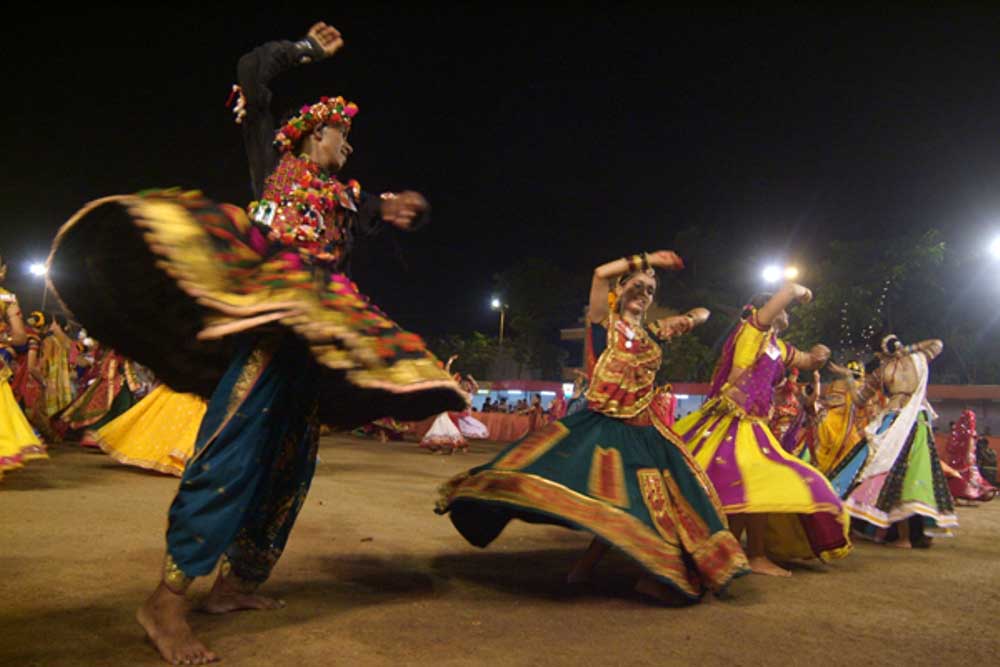
Hindu community in the UK, on 5 October, marked the end of Navratri, the nine-day Hindu festival celebrated with pomp and enthusiasm by the Hindus, especially the Gujarati Community. The word Navratri is made up of two words, nav which means nine and Ratri which means night. Thus Navratri, is a festival celebrated for nine nights.
The festival is devoted to feminine divinity, referred to as ‘Shakti’, which means energy or power. Garba, a Gujarati dance form is a hallmark for Navratri. Every night, for nine days, groups of people come together in a circle after the prayers are said, and dance around a decorated earthenware pot, which represents a Goddess shrine. The dancers wear a costume and often carry a pot on their heads, referred to as Garbi.
These dances are organised both on a large and small scale, in every nook and corner of Gujarat and they often go on till late at night. The circle represents the Hindu view of time. As the cycle of time revolves, from birth to life to death to rebirth, the only thing that is constant is the Goddess, an unmoving symbol in the midst of all of this unending and infinite movement. The dance symbolises that God, represented in feminine form, in this case, is the only thing that remains unchanging in a constantly changing universe
On most occasions, another Gujarati dance form, ‘Dandiya’ is also performed along with Garba. This dance, like Garba, is also done in small groups with each person holding a pair of small decorated sticks. The dandiya rass, as it is called, is devoted to Lord Krishna and depicts the dance of Gopis (female guardians) of Lord Krishna.
The nine nights are divided into three separate nights, each dedicated to a different Goddess. The first three nights are dedicated to Goddess Durga, the second three to Goddess Lakshmi and the final three nights are dedicated to Goddess Saraswati. The festival overall marks the nine days of war between Shakti, the form of divine feminity and Mahisasur, a demon. It is believed that Mahisasur, was blessed with a gift of immortality and was destined to be killed only by a woman.
As the demon got powerful, Lord Shiva, Lord Brahma and Lord Vishnu, the three most important and powerful Gods created Shakti, a powerful feminine form to defeat Mahisasur. The battle went on for nine days and Mahisasur was eventually killed on the tenth day.
Apart from Mythology, Navratri is also celebrated to mark fertility and monsoon harvest, represented by a mound of fresh soil where grains are sown. This soil too is worshipped and watered for nine days.
Here, in the UK too, the Gujarati community tries to make the celebration as homely as possible. Hindu temples and associations across the UK organised Garba nights and events.
Jinisha Bhanushali, a Gujarati student at the University of Westminster, who celebrated and attended Garba events held in Northolt said: “It’s the happiest time of the year for me, no music and dance makes me so happy as much as the Garba beats, also for me it’s the festival with colours, lights, music and faith.” On celebrating the festival outside India for the first time she said: “Luckily I found the right bunch of people to celebrate with so I did have fun but missed my family a lot”.
Another student, Nikita Parikh, from the Gujarati community, studying in Leeds said “Garba is actually name of the pot which is filled with a akhand jyot means Diya for nine days ,This is kept in front of Goddess .For nine days people keep fast, traditionally in different ways. Some eat fruits only, some eat only cereals and pulses which are cooked no vegetables, milk, oil(ambil) which Gujaratis do for nine days some eat sabudana, sweet potatoes. After the days schedule the ladies usually take this pot with Diya on head and dance This is Garba.”
In the UK, as per latest official data from ONS, there are 964,166 Hindus. Most practising Hindu communities observed Navratri as per their local and traditional customs. The Bengalis, for instance, observed Durga Puja, while some communities fasted for nine days. Similarly, the south Indian community too observed the nine-day festival in a manner their custom dictates.
Several Hindu Mandirs (temples) across the UK organised prayers and celebrations for 9 days. The Murugan Hindu Mandir in Leeds , for instance, organised evening regular prayers for 9 days. The mandir also organised a Garba dance competition on 1 October and a fancy dress competition for kids on 2 October.
The festive fever among the Hindu Community has just started, as just in a few weeks’ time, they will be celebrating Diwali, the biggest Hindu festival, also called the festival of lights.
Wishing our readers who celebrate a very festive season.